
Your auto insurance declarations page is a compact summary of the policy you bought. It is worth checking when the policy starts, when it renews, and any time you change cars or drivers. A quote is only useful if the final policy shows the coverage you meant to choose.
First, confirm who and what the policy covers
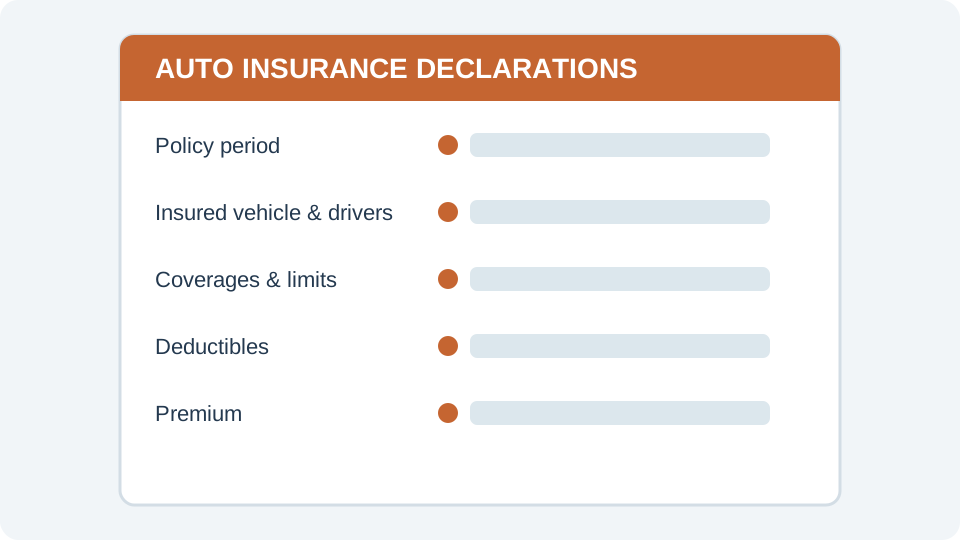
Check the named insured, address, policy number, effective and expiration dates, listed drivers, and every vehicle identification number. If a car was replaced or a household driver was omitted, ask the insurer or agent to correct the policy. The National Association of Insurance Commissioners' auto-insurance shopping tool shows the kinds of information a declarations page commonly contains.
Read each coverage line separately
Florida generally requires a registered vehicle to carry at least $10,000 of personal injury protection (PIP) and $10,000 of property damage liability (PDL). Those are different protections: PIP addresses covered injuries regardless of fault, while PDL addresses damage you cause to someone else's property. The Florida Driver License Handbook explains the registration requirement. Other situations can impose additional requirements, so do not treat these two minimums as a complete coverage recommendation.
Look separately for bodily injury liability, uninsured or underinsured motorist coverage, collision, comprehensive, medical payments, rental reimbursement, and roadside assistance. A missing line usually means you should ask whether that coverage is included. Florida's Department of Financial Services coverage overview explains what these common coverages are designed to address. The policy's terms, exclusions, and endorsements—not this illustration—determine what a claim pays.
Do not confuse limits, deductibles, and premium
A limit is the maximum the insurer will pay under a particular coverage, subject to the policy. A deductible is the amount you may pay toward a covered physical-damage claim before the insurer pays. A premium is the cost of the policy for its stated period. The declarations page lets you compare these figures across quotes, but compare the same coverage choices and drivers before declaring one price lower.
If you need an FR44 or SR22, check the filing too
A standard declarations page may not by itself prove that a required financial-responsibility certificate was filed. Tell your agent what your state notice requires and ask for confirmation of the filing. Our FR44 guide and SR22 guide explain those needs in more detail. Foxx can compare multiple carriers for your specific circumstances and help with the filing, but no carrier or quote is guaranteed to be the cheapest.
Use the page as a five-minute review
When your new or renewal documents arrive, compare the declarations page with the quote you approved. If the dates, vehicle, drivers, limits, or deductible are not what you expected, contact your agent promptly. Want a second look at your options? Request a Foxx Insurance quote and tell us which coverages matter to you.